
Qinyu ZHOU
周沁宇
Ph.D Candidate
Department of Aeronautical and Aviation Engineering
The Hong Kong Polytechnic University
Origin
Pudong, Shanghai, China
Research Interest
Human factors and ergonomics
Safety engineering
Safe separation design in urban air mobility
This research topic is funded by:
Research Committee of the Department of Aeronautical and Aviation Engineering, The Hong Kong Polytechnic University for support of the project (RN4L)
Incorporating pilot mental stress into no-fly zone boundaries through a human factors approach to safe separation design in urban air mobility
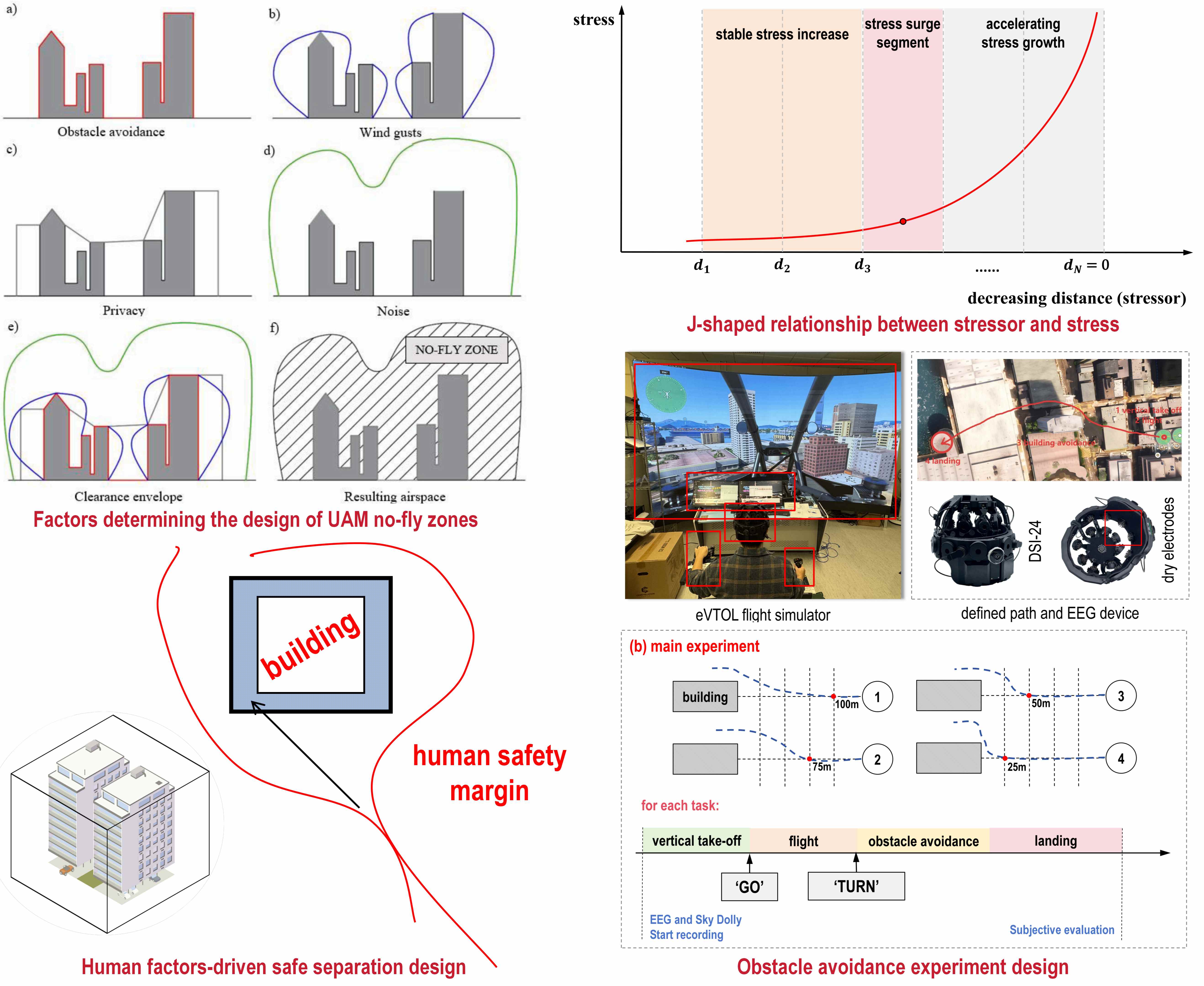
The outer boundaries of the no-fly zones in urban air mobility (UAM) are defined through factors such as weather conditions, noise and navigation. This study aimed to include human factors into the spatial envelop design of no-fly zones in low-altitude airspace. A simulating experiment of electric vertical take-off and landing (eVTOL) flights based on four obstacle avoidance distances was conducted. Psychological, physiological and behavioral indicators were extracted to reflect stress levels and capture the distance showing the surge of stress. To calculate the individual overall stress from the three modalities of indicators, this study proposed a J-shape guided multi-feature fusion framework through extracting the properties of monotonic increasing and slope increasing from the J-shape relationship between stressors and stress to execute reliable individual-level fusion. The results showed that 65.91% of the participants showed stress surge on the 50-to-25-meter separation, while the 75-to-50-meter separation covered 86.36% participants. Robustness analysis tested the stability of the 75-meter separation under different fusion, modality, feature and weighting settings. Therefore, the 75-meter separation with corresponding time-to-collision (TTC) as 3.18 seconds was selected for an engineering design reference of human factors-driven safety separation. These conclusions bring a new human-centric design for safety assurance in UAM.
Separation Assurance in Low-Altitude Cross-Sea Corridors:
Investigating the effects of Nearby eVTOL Encounters on Pilots’ Self-Speed Perception Bias
.jpg?h=d8800dadb479b9fab12af86b5a90dc92)
Future dense advanced air mobility (AAM) corridors may expose pilots to nearby electric vertical take-off and landing aircraft (eVTOLs), whose relative motion can bias pilots’ self-speed judgements, particularly during low-altitude cross-sea flights where stable external visual references are sparse. This study aimed to incorporate this human factor into separation assurance in AAM corridors through examining the effects of nearby eVTOL motion and spatial configuration on pilots’ self-speed perception. Forty-one participants completed speed perception under 36 simulated flight conditions through a 2 (relative speed difference: 10 and 20 knots) × 3 (lateral position: -20, 0 and +20 m) × 6 (longitudinal separation: 0-50, 50-100, 100-150, 150-200, 200-250 and 250-300 m) within-participant design. Subjective ratings and electroencephalograph (EEG) patterns were used to represent the joint speed perception response. Repeated-measures multivariate analysis of covariance (RM-MANCOVA) was conducted adopting sleep duration, operational proficiency and threat sensitivity as covariates. Results showed that relative speed difference, lateral position and longitudinal separation produced significant multivariate main effects on the joint speed perception response (P < 0.001) and the interactions were also significant (P < 0.05), but none of the covariates were significantly associated with the joint speed perception response. These findings indicate that self-speed perception depends on the combined relative speed and spatial configuration of nearby traffic, providing human performance evidence for coordinating speed, longitudinal separation and lateral position in separation assurance in AAM corridors.
Lessons learned from Low-Altitude Accident Reports Utilising Artificial Intelligence for Developing Future Advanced Air Mobility Policy
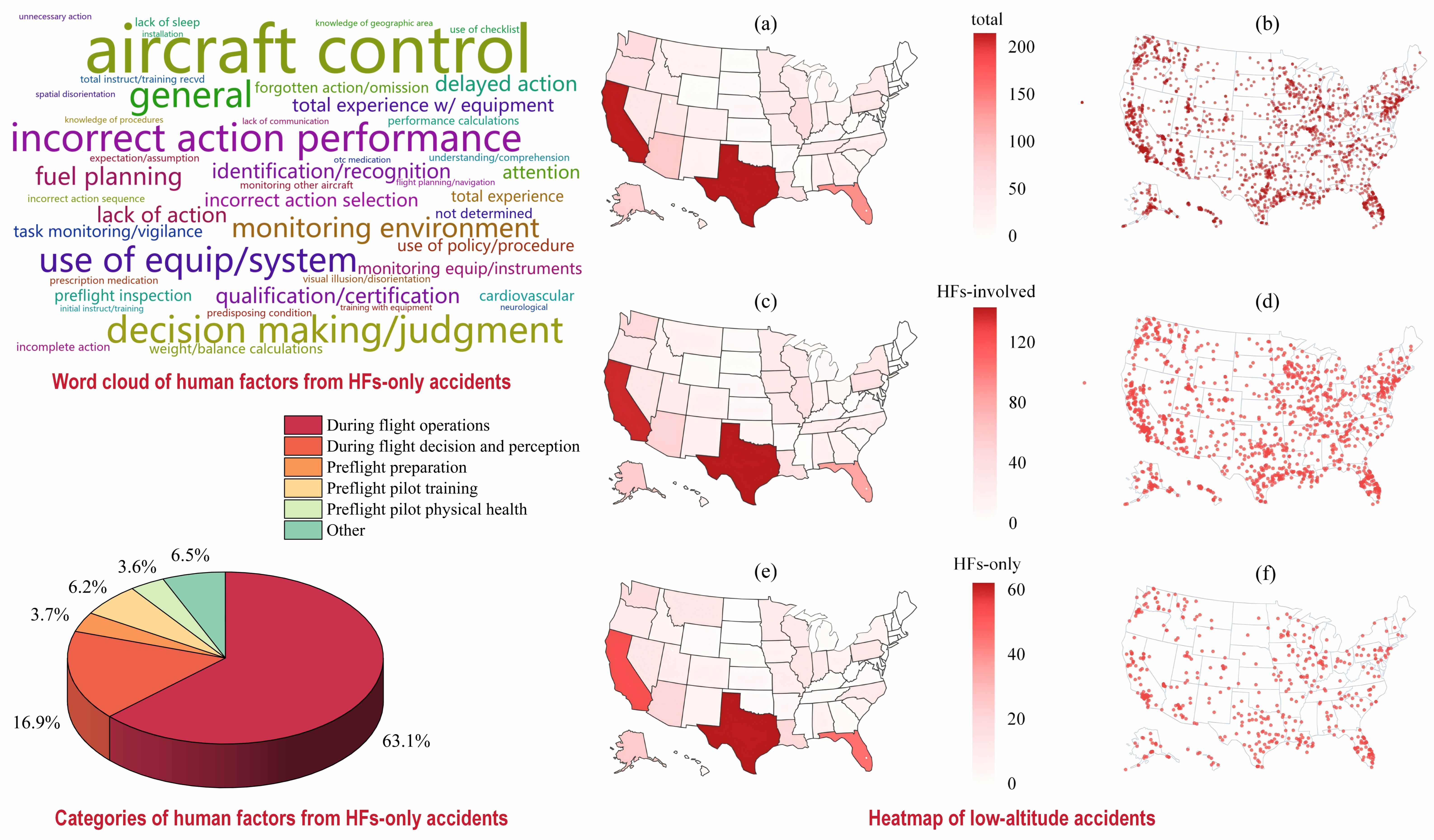
The technological advancement of various air transportation vehicles such as electric vertical take-off and landing (eVTOL) is bringing advanced air mobility (AAM) closer to practicality and popularity compared to the helicopter services, yet factors related to the low-altitude accidents are not well understood. This study aims to investigate factors associated with the occurrence and severity of low-altitude helicopter accidents utilising artificial intelligence. Completed helicopter accidents from 2010 to 2024 were extracted and marked with labels according to the involvement of human factors (HFs) in the accident causes through a manual-large language model (LLM) hybrid framework. The labels included three categories: HFs-only accidents, multi-cause accidents including HFs and non-HFs-involved accidents. Based on the HFs-only accidents, descriptive analysis was applied to illustrate HFs types and frequencies and examine the accident distribution by years, states and flight purposes. Then, variables associated with pilot information were extracted and statistical analysis based on logit regression model was conducted for determinants of occurrence and severity of the HFs-only accidents. The results showed that variables including second pilot presence and last Federal Aviation Administration (FAA) medical exam were significantly associated with the occurrence of HFs-only accidents, while airplane rating, last FAA medical exam and total flight time in all aircraft were significantly correlated with the severity of HFs-only accidents. A sensitivity analysis was further conducted to compare the statistical results from HFs-only accidents and HFs-involved accidents. Discussions on these findings bring implications to new safety standards of AAM pilot qualification policy.