
Qinyu ZHOU
周沁宇
Ph.D Candidate
Department of Aeronautical and Aviation Engineering
The Hong Kong Polytechnic University
Origin
Pudong, Shanghai, China
Research Interest
Human factors and ergonomics
Safety engineering
Safety protection and fatigue management
in manufacturing industry
This research topic is funded by:
国家自然科学基金,面上项目,51775325,面向智能车间的脑-机交互理论、方法
及其在风险预警中的应用研究,2018-01 至 2021-12,已结题。
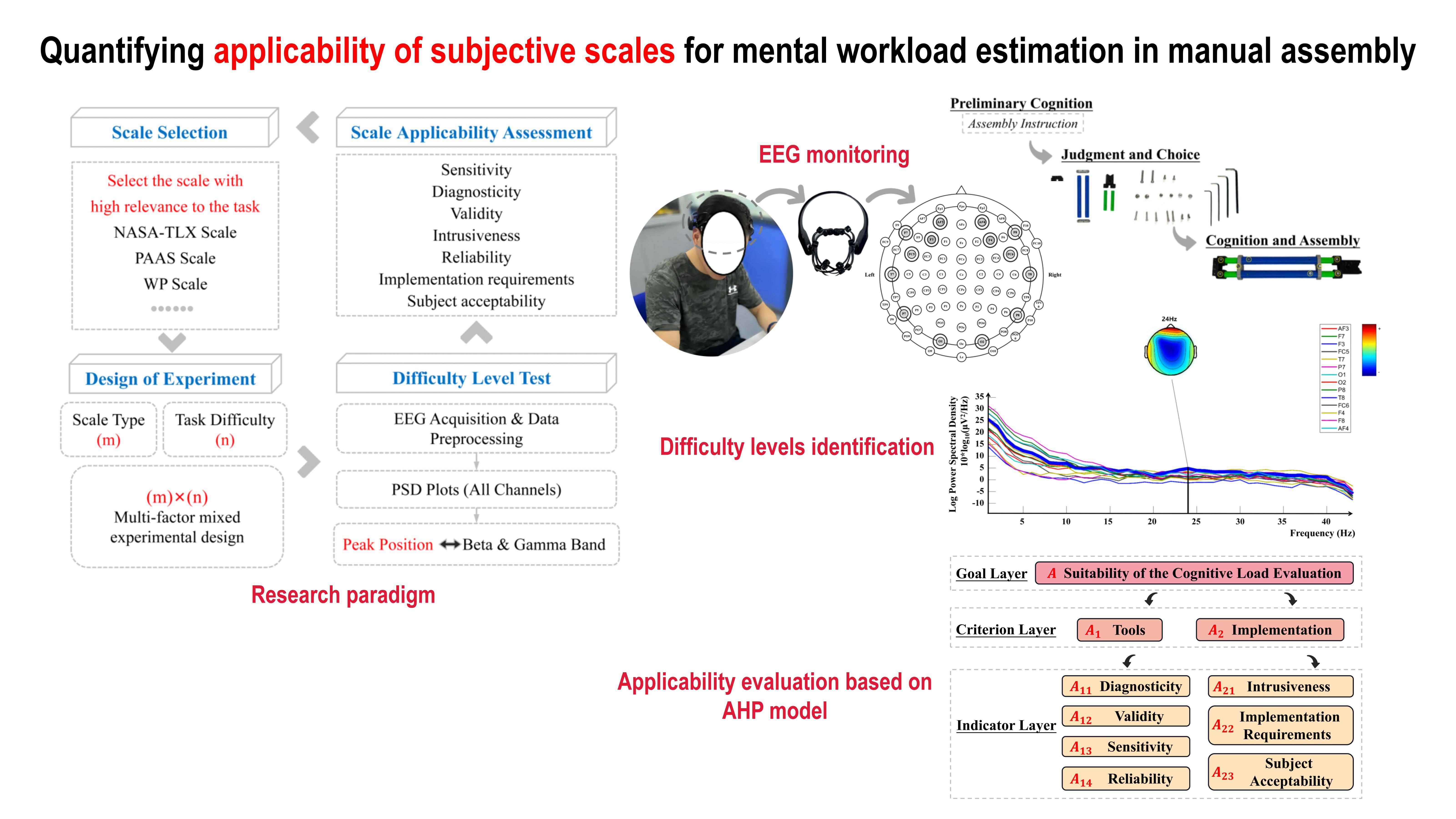
Subjective scales have different kinds of applicability in diverse fields. This study intends to implement a quantitative approach to determine the applicability of subjective scales in manual assembly work and evaluate the cognitive load of assembly workers. A multi-scale research paradigm based on subjective evaluation method is proposed. Three typical task stages are extracted from the process of assembly work. The National Aeronautics and Space Administration Task Load Index (NASA-TLX) scale, PAAS scale and Workload Profile Index Ratings (WP) scale are selected for the design of 3×3 multi-factor mixed experiment. The power spectrum density (PSD) characteristics of electroencephalogram (EEG) are utilized to identify the difficulty levels of the three task stages. The relevant indicators of scale applicability are assessed. The results show that in terms of sensitivity, NASA-TLX scale reaches the highest sensitivity (F=999.137, P=0<0.05). In terms of validity, NASA-TLX scale possesses the best concurrent validity (P=0.0255<0.05). In terms of diagnosticity, NASA-TLX scale based on 6 dimensions takes on the best diagnostic performance. In terms of subject acceptability, WP scale performs the worst. According to the Analytic Hierarchy Process (AHP) model, the applicability scores of NASA-TLX scale, PAAS scale and WP scale are determined as 3, 2.55 and 1.6714, respectively. Therefore, NASA-TLX scale is regarded as the most suitable subjective evaluation questionnaire for assembly workers, which is also an effective quantitative evaluation method for the cognitive load of assembly workers.
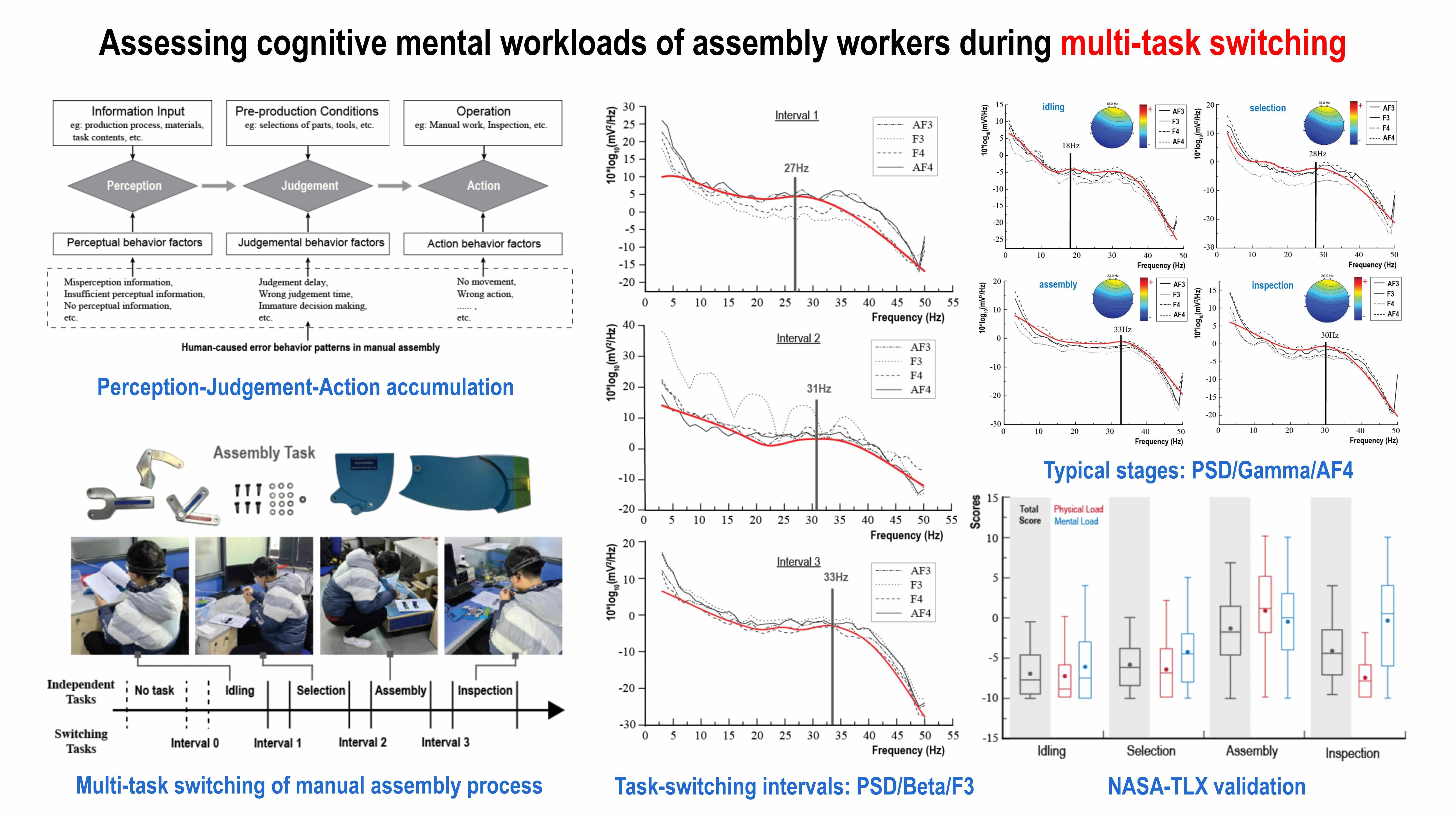
Assembly tasks are typical manual operations in the manufacturing industry. Complex assemble tasks with multiple steps often require rapid judgment and action under time pressure and cause most human-related errors. The task switching and action transitions are major sources of these errors. This study intends to implement an electroencephalography (EEG) approach to quantitatively evaluate the mental workload during task switching and transition. The time-frequency and spectrum analysis were utilized to compute and reflect the task demand between the intervals of individual tasks. This study developed an experiment to validate the proposed assessment approach and benchmarked the results with the National Aeronautics and Space Administration task load index (NASA-TLX) subjective evaluation scale analysis. The results show that the average value of the power spectral densities (PSDs) of the gamma band signal of the AF4 channel and the beta band signal of Channel F3 show distinctive signal patterns among task stages and intervals. During the interval between the idling stage and the part selection stage, the peak of the PSD envelope increased from 18Hz to 27Hz, suggesting advanced cognition increases the mental workload of the interval between different tasks. Therefore, the task switching period cannot be regarded as rest and need to be optimized with better task organization.
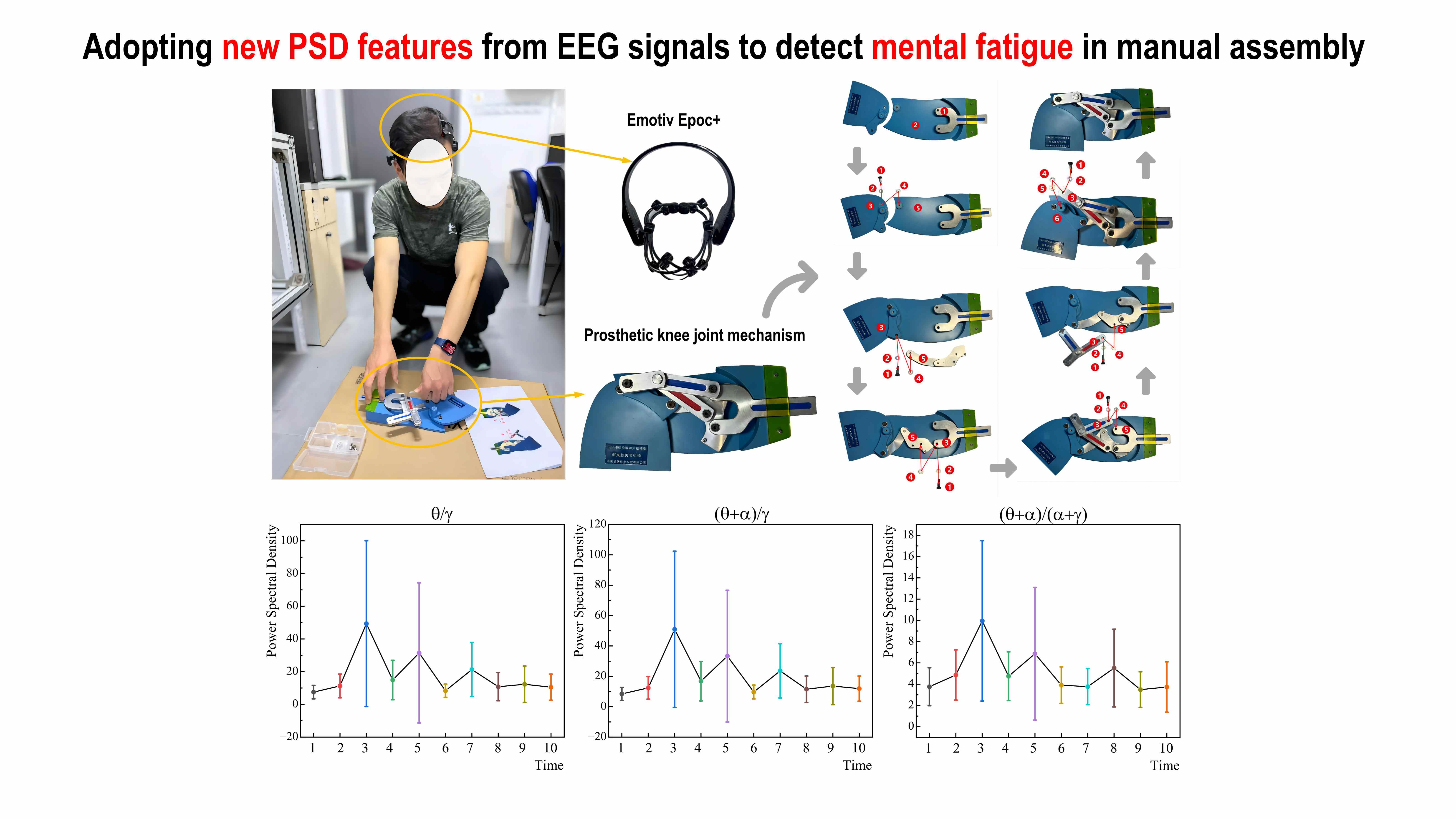
Manual assembly work belongs to a typical task with high mental demands in workshop. If the mental workload of assembly workers reaches too high, it is easy to influence work efficiency and even threaten operation safety, which may lead to workshop emergencies. To detect workers’ mental fatigue during manual assembly process, this study aims to propose new features from electroencephalograph (EEG) signals. An experiment was developed based on prosthetic knee joint assembly to induce subjects’ mental fatigue. The EEG signals of subjects as well as the scores of National Aeronautics and Space Administration Task Load Index (NASA-TLX) scale were collected during the experiment. Through the observation of the variation from power spectral density (PSD) features in θ, α, β and γ bands of AF3 channel, the changes of mental fatigue levels were identified. Then three new PSD features from AF3 channel based on the ratio of slow wave to fast wave were constructed to recognize mental fatigue levels of manual assembly workers. The three PSD features included θ/γ, (θ+α)/γ and (θ+α)/(α+γ). Finally, a Bayesian optimized support vector machine with a radial basis function kernel (BOA-RBF-SVM) was adopted to verify the effectiveness of the three PSD features. The results showed that the average classification accuracy of BOA-RBF-SVM taking θ/γ, (θ+α)/γ and (θ+α)/(α+γ) as input reached 85.52%, which was superior to other feature combinations as input. Therefore, the PSD features based on spectral components from EEG signals proposed in this study are proved to be able to effectively identify mental fatigue levels during manual assembly process, providing a reference on EEG features selection for the prevention of workshop emergencies.
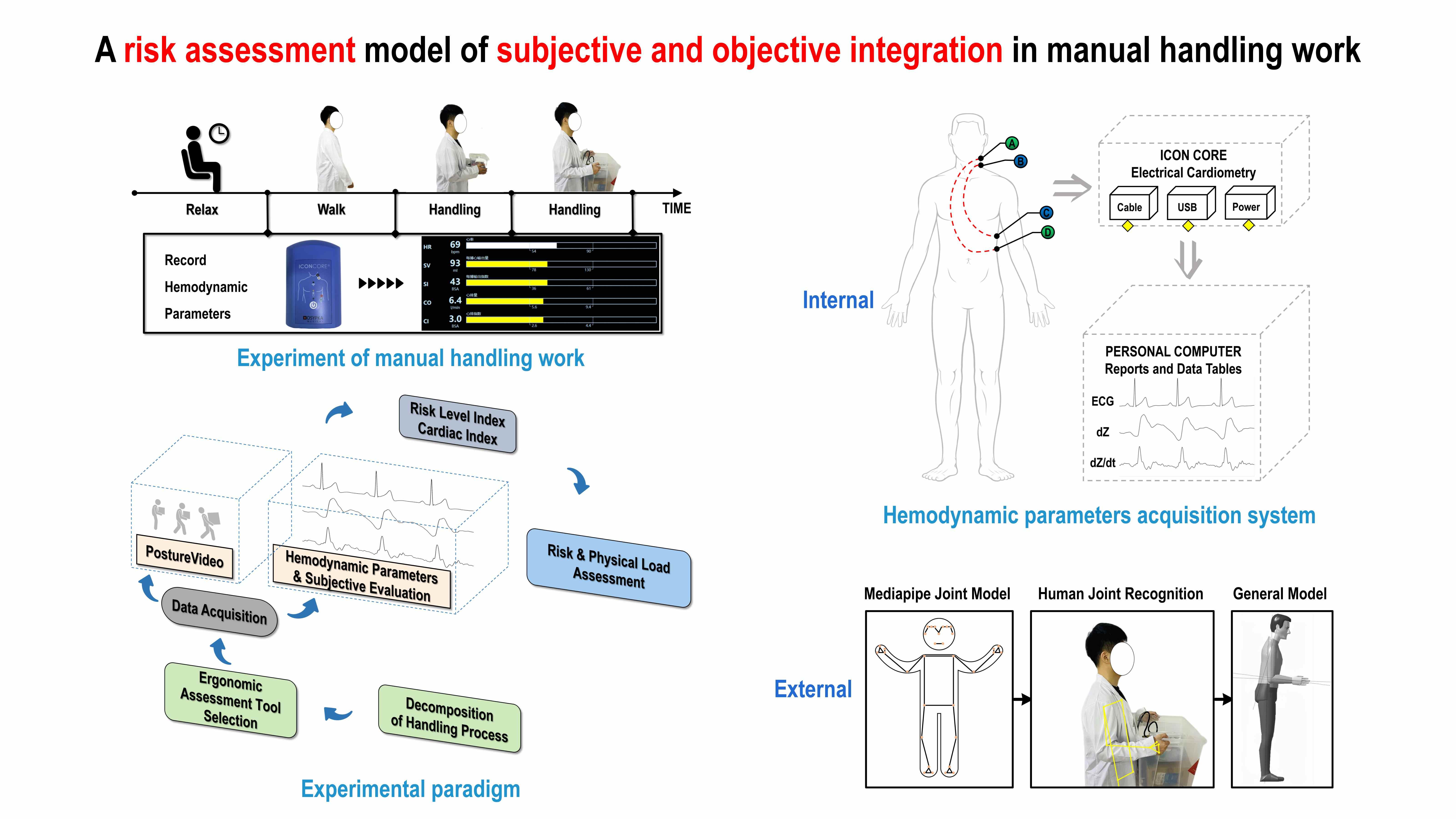
The main hazards in the process of manual handling work are triggered by human factors and ergonomics. This study is intended to implement a valid approach to quantitatively evaluate the risk level during manual handling work. A risk assessment model for manual handling workers was proposed based on subjective and objective correlation. A simulation experiment of manual handling process was developed and an ergonomics evaluation method was carried out. The 33-point human joint model of BlazePose neural network and the Rapid Upper Limb Analysis (RULA) method were utilized to determine the risk posture and risk index of the manual handling workers. This study brought together hemodynamic parameters and the score of Borg Rating of Perceived Exertion (RPE) scale and Physical Resources Scale (PRS) to obtain the final comprehensive index of work risk. The results showed that the risk indexes from the three stages of the experiment obtained by RULA method were 3, 4 and 7. And the scores of comprehensive indexes obtained by the risk assessment model were 1.841, 1.900 and 1.987, suggesting that the evaluation model based on subjective and objective correlation had the same ability to determine the risk levels of different handling tasks. Therefore, the risk assessment model proposed in this study verified the effectiveness of the comprehensive evaluation index integrating hemodynamic parameters and subjective evaluation scores.